

Understanding fabric durability for lasting home textiles
TL;DR:
- Fabric durability depends on multiple performance properties like abrasion resistance, pilling, colorfastness, and strength, which collectively determine how well textiles hold up in home environments.
- Evaluating these properties through standardized tests ensures accurate assessment, guiding homeowners to select fabrics suited for their specific use, traffic, and exposure conditions.
- Prioritizing construction quality alongside ratings helps ensure textiles remain beautiful and functional for years, making durability a comprehensive, multi-dimensional standard rather than a single metric.
When selecting fabric for custom drapery or upholstery, understanding fabric durability is rarely as straightforward as it appears. Many homeowners assume that a thicker fabric or a higher thread count automatically means a longer-lasting material, but that thinking leads to costly mistakes. Durability is actually a combination of several distinct performance properties, including abrasion resistance, pilling behavior, colorfastness, and structural strength. Each one protects your fabric against a different type of wear. Knowing how they work together is what separates a textile that looks beautiful for a decade from one that disappoints within two years.
Table of Contents
- What is fabric durability and why it matters for your home
- Key fabric durability tests explained: abrasion, pilling, colorfastness, and strength
- Durability standards and metrics: double rub count, Martindale, Wyzenbeek, and pilling grades
- Appearance retention: why pilling and colorfastness matter for custom drapery and upholstery
- Choosing durable fabrics for your home: matching durability to room use and lifestyle
- Our perspective: durability ratings are a starting point, not a finish line
- Explore premium fabrics built for lasting beauty at Beautiful Windows Elgin
- Frequently asked questions
Key Takeaways
| Point | Details |
|---|---|
| Durability is multi-factorial | Fabric durability combines strength, abrasion resistance, pilling, and colorfastness to ensure long-lasting use in homes. |
| Know your tests | Understanding abrasion, pilling, and colorfastness tests helps choose fabrics that perform well in daily home environments. |
| Match fabric to use | Select fabrics with durability ratings suited to your room’s wear level, sunlight exposure, and function for best results. |
| Appearance matters | High pilling grades and colorfastness prevent early visual wear before structural damage occurs. |
| System durability approach | Consider fabric strength, seam quality, and surface integrity together rather than relying solely on one durability metric. |
What is fabric durability and why it matters for your home
Fabric durability is not a single measurement. It is a coordinated set of performance properties that together determine how well a textile holds up under the conditions of daily home life. As home textile durability should be evaluated as a set of correlated performance targets rather than a single property, treating it as one-dimensional puts your investment at risk.
For upholstery, durability means resisting the friction of daily sitting, the pressure of body weight, and the gradual wear of fabric fibers against each other. For drapery, it means maintaining color and structural integrity despite repeated sun exposure, dust, and the mechanical stress of opening and closing. A fabric can excel in one area and fail in another, which is why selecting textiles for home comfort requires looking at the full picture.
Here are the core durability properties every homeowner should understand:
- Abrasion resistance: How well the fabric surface withstands repeated rubbing without breaking down
- Pilling resistance: How well the fabric prevents small fiber balls from forming on its surface
- Colorfastness: How reliably the fabric retains its color when exposed to sunlight, washing, or friction
- Breaking and tear strength: How much force the fabric can withstand before tearing at seams or across its surface
- Appearance retention: How well the fabric maintains its original texture and finish over time
Each property matters differently depending on where and how the fabric is used. Skipping even one of these evaluations when choosing fabric for high-use spaces can result in premature wear, fading, or pilling that makes beautiful textiles look neglected well before their time.
Now that you know durability is multi-dimensional, let’s explore the key tests and standards used to measure these properties.
Key fabric durability tests explained: abrasion, pilling, colorfastness, and strength
Standardized testing exists precisely because “feels durable” is not a reliable standard. Fabric manufacturers use a defined set of laboratory tests to quantify how a textile performs under controlled stress. Understanding these tests gives you the vocabulary and judgment to evaluate fabric specifications with confidence.
Abrasion testing subjects a fabric to repeated mechanical rubbing, counting the cycles until the surface breaks down. The number of cycles completed before failure is reported as the fabric’s abrasion resistance. For upholstery, this number is often called the “double rub count,” and it directly corresponds to how many times a person sitting down and getting up rubs the fabric surface.
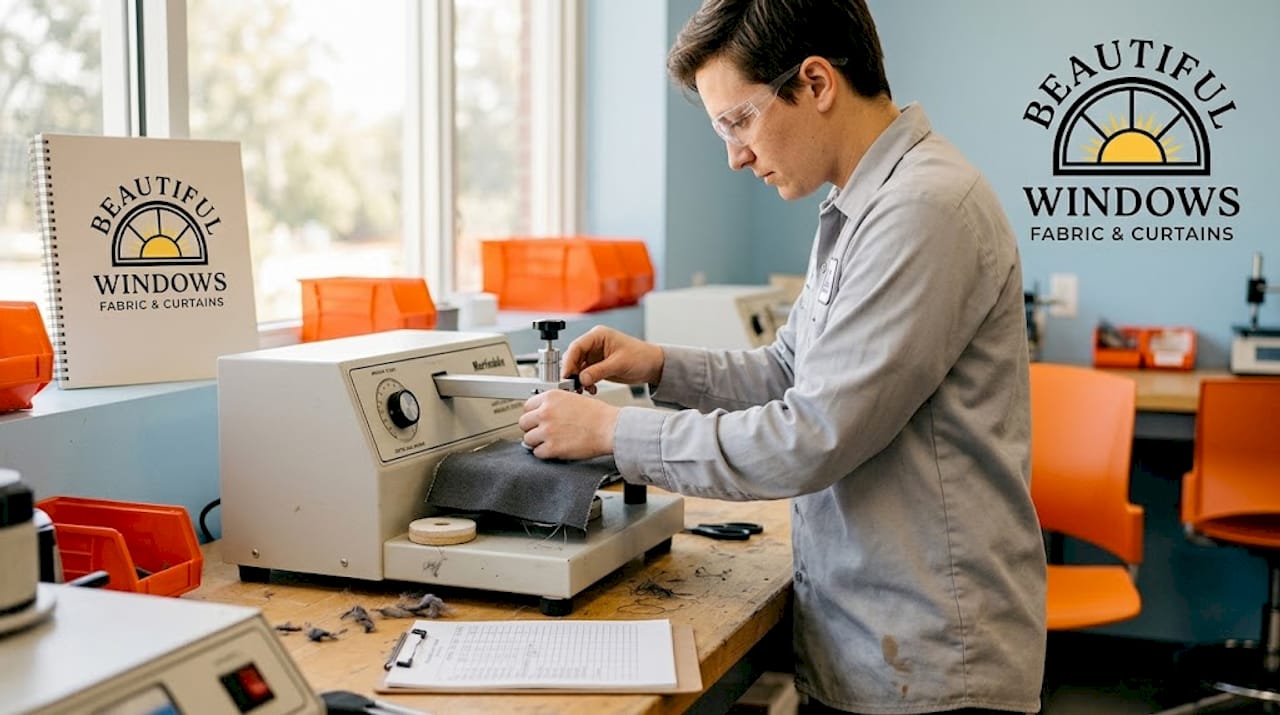
Pilling tests evaluate how a fabric forms surface fiber balls when rubbed against itself or another surface. Results follow a visual pilling grading scale from 1 to 5, where Grade 5 means no pilling and Grade 1 means severe pilling. Synthetic blends tend to pill more persistently because the fibers are stronger and harder to break off, so those tiny balls stay anchored to the surface.
Colorfastness testing simulates household sunlight exposure using xenon-arc lamps and grades fading resistance using Blue Wool standards rated L1 through L8. An L1 rating means the fabric fades very quickly; L8 means it resists fading even under extended light exposure. For curtains on south-facing windows, this number is critical.
Strength testing varies by fabric construction. Woven fabrics are typically assessed using breaking strength, which measures tension applied across the weave until failure. Knitted or nonwoven fabrics often use bursting strength, which applies pressure from multiple directions. Tearing and breaking strength are matched to fabric construction type to give a reliable picture of structural durability.
Here is how to use these tests when evaluating fabric for your home:
- Request the technical data sheet from your fabric supplier, which should include abrasion, pilling, and colorfastness ratings.
- Match the test results to your intended use: higher abrasion resistance for seating, higher colorfastness for window treatments.
- Compare pilling grades and prioritize Grade 4 or above for any fabric that will experience repeated contact.
- Look for fabric testing tips specific to window treatments when selecting drapery materials.
Pro Tip: If a fabric supplier cannot provide standardized test results, treat that as a red flag. Quality fabric at a premium price point should come with documented performance data.
With tests clearly defined, let’s compare commonly used durability metrics for different home fabric types including upholstery and drapery.
Durability standards and metrics: double rub count, Martindale, Wyzenbeek, and pilling grades
Two primary testing methods dominate upholstery fabric evaluation: Wyzenbeek and Martindale. Both measure abrasion resistance, but they use different motion patterns, which means their numbers are not interchangeable. Martindale and Wyzenbeek produce results on different scales, and 30,000 or more double rubs is a reliable baseline for sofa fabric durability.
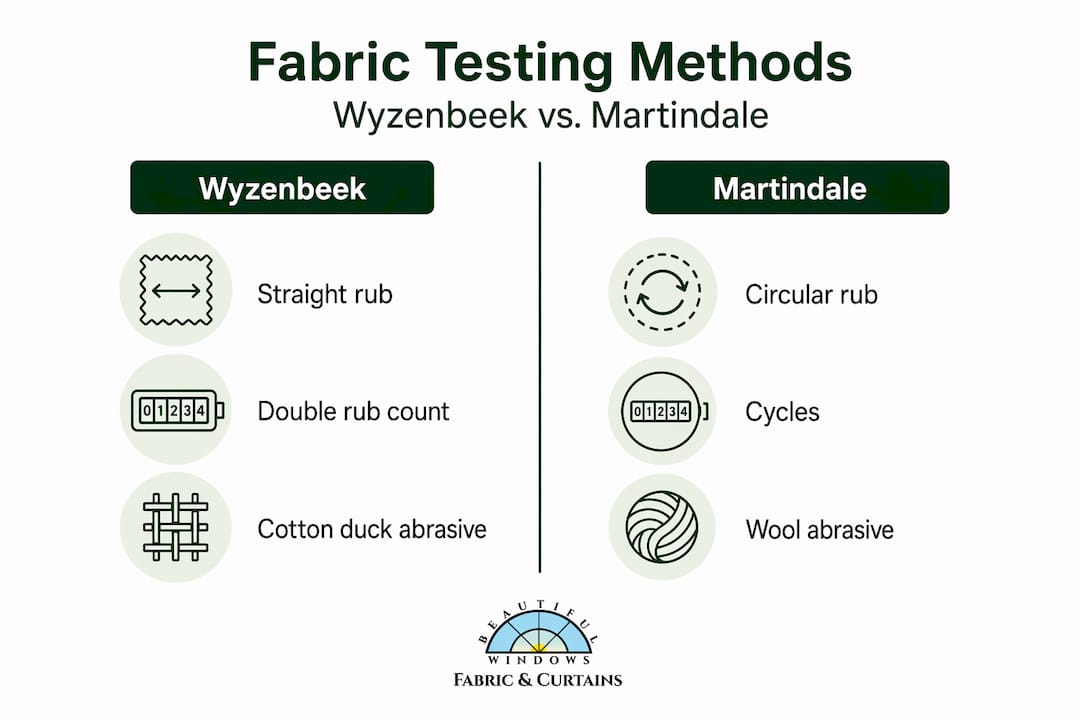
Wyzenbeek uses a back-and-forth rubbing motion with cotton duck or wire mesh as the abrasive. It reports results in “double rubs,” where one double rub equals one back-and-forth cycle. The Wyzenbeek method is the standard most commonly used by American fabric manufacturers and is the basis for the Fabric Wearability Code used to rate upholstery.
Martindale uses a circular, multi-directional rubbing motion that mimics how fabric wears in real-world seating. It is the preferred standard in Europe. Because the motion is more thorough, Martindale counts are often lower than Wyzenbeek counts for the same fabric, but they tend to reflect real-world wear more accurately.
| Standard | Motion type | Common use | Residential baseline |
|---|---|---|---|
| Wyzenbeek | Back-and-forth | U.S. upholstery | 15,000+ double rubs |
| Martindale | Multi-directional circular | European upholstery | 20,000+ cycles |
| Pilling grade | Visual scale 1-5 | All home textiles | Grade 4 or 5 |
| Colorfastness | L1-L8 light scale | Drapery and upholstery | L5 or above |
For residential use, the general durability categories break down as follows:
- Light duty: Under 15,000 double rubs. Suitable for decorative pillows or infrequently used bedroom chairs.
- Medium duty: 15,000 to 30,000 double rubs. Appropriate for living room chairs and occasional-use sofas.
- Heavy duty: 30,000 or more double rubs. Recommended for family room sofas, ottomans, and high-traffic seating.
Tight weave construction and reinforced seam integrity also affect real-world durability beyond what rub counts alone capture. A fabric with a 40,000 double rub rating but loose seam construction can still fail prematurely at stress points. When choosing drapery fabrics, similar logic applies. A tightly woven linen or jacquard with good structural integrity will outlast a loosely woven fabric of the same fiber content, even without abrasion testing for drapery specifically.
Pro Tip: When comparing fabrics from different manufacturers, always confirm which testing standard was used before comparing their double rub counts. A Martindale number and a Wyzenbeek number applied to the same fabric tell very different stories.
Understanding these standards lets you match fabric properties to your home’s specific use scenarios and needs.
Appearance retention: why pilling and colorfastness matter for custom drapery and upholstery
A fabric can remain structurally intact long after it has stopped looking presentable. In real upholstery failure, pilling and color loss often appear before structural failure, meaning your fabric may look worn out while it is still technically functional. For homeowners investing in custom upholstery or designer drapery, appearance retention is not a secondary concern. It is central to the value of the investment.
Pilling occurs when short or broken fibers migrate to the surface and tangle together under friction, forming the familiar small fiber balls. Synthetic fibers and synthetic blend fabrics are particularly prone to this because their fibers are stronger and do not break off the way natural fibers do. The pills stay attached and accumulate. A pilling grade of 4 or 5 on any fabric you plan to use for seating or high-contact upholstery is worth prioritizing from the start.
For drapery, colorfastness to light is the most important appearance retention factor. Colorfastness tests use xenon-arc lamps to simulate household sunlight exposure, then grade the fabric’s fading against the Blue Wool standard scale from L1 to L8. South-facing and west-facing windows receive the most intense daily sun, making L5 or above a meaningful threshold for those applications.
Consider these appearance retention priorities when selecting fabric:
- For sofas and armchairs, prioritize pilling grades of 4 to 5.
- For sun-exposed drapery, target colorfastness ratings of L5 or above.
- Avoid loose-weave fabrics in high-friction zones regardless of abrasion test scores.
- Consider lining drapery panels to reduce direct UV exposure on the face fabric.
Here is a practical order of evaluation for appearance durability:
- Check the pilling grade first for any upholstery fabric going into a frequently used room.
- Check the colorfastness rating second for any drapery fabric near windows.
- Confirm the weave density by examining the fabric in person or requesting a sample, as tight weaves resist surface wear more effectively.
- Review drapery fabric selection guidance to align fabric choice with your specific window conditions.
Choosing durable fabrics for your home: matching durability to room use and lifestyle
Understanding how to choose durable fabrics becomes practical only when you connect the specifications to your actual living conditions. A fabric that is ideal for a formal sitting room used twice a week is entirely different from one that needs to hold up in a family room with children and pets.
A requirements matrix for fabric durability balances abrasion resistance, tear strength, and appearance retention against your home’s specific conditions. Here is how to build one for your own space:
- Identify the intensity of use for the room: light, moderate, or heavy daily traffic.
- Note the sun exposure level for any window-facing fabric or upholstery near windows.
- Consider any specific household factors such as pets, children, or frequent entertaining.
- Match the durability ratings you need: double rub count, pilling grade, and colorfastness level.
- Consult designer fabric durability insights to understand how premium fabric construction affects long-term performance.
| Room type | Recommended double rubs | Pilling grade | Colorfastness |
|---|---|---|---|
| Formal sitting room | 15,000 to 25,000 | Grade 3 to 4 | L4 to L5 |
| Family room or den | 30,000 or more | Grade 4 to 5 | L5 or above |
| Sun-facing window treatments | Not applicable | Grade 3 or above | L6 to L8 |
| High-contact upholstery (arms, seats) | 40,000 or more | Grade 5 | L5 or above |
High-contact upholstery zones, such as the arms and seat cushions of a sofa, benefit from tight weaves, reinforced seam construction, and fabric backing. These structural elements add durability that rub count numbers alone do not fully capture. Reviewing curtain fabric types for durability is equally worthwhile before finalizing any window treatment fabric, as fiber content and weave construction interact differently in drapery versus upholstery contexts.
Pro Tip: Request fabric samples before ordering by the yard. Hold the sample up to a light source to assess weave density, rub it gently with your thumb to test surface fiber behavior, and check the back of the fabric for backing or coating that adds structural support.
Our perspective: durability ratings are a starting point, not a finish line
Here is something the fabric specification sheets will not tell you. Two fabrics with identical double rub counts can perform very differently in your home, and the gap has nothing to do with the number itself.
We have seen homeowners purchase fabric with impressive abrasion ratings, only to experience disappointing results within a couple of years because the fabric had poor seam integrity, no backing, or a loose weave that caught and snagged under daily use. The rating told part of the story. The construction told the rest.
The more useful mindset is to treat durability ratings as a minimum qualification, not a guarantee of performance. A fabric that meets your rub count threshold but scores poorly on pilling resistance will still look worn long before it fails structurally. A fabric with excellent colorfastness but a poor-quality lining will still show premature fading at the folds of a drapery panel where the lining deteriorates first.
What experienced designers understand that most homeowners do not is that fabric durability is as much about construction quality as it is about fiber content or test scores. Tightly woven jacquards and embroidered upholstery fabrics, when properly lined and installed, consistently outlast fabrics with higher numerical ratings but lower construction standards. The investment in quality construction, proper lining, and professional installation pays back in textiles that remain beautiful for a decade or more.
Explore premium fabrics built for lasting beauty at Beautiful Windows Elgin
Finding fabric that performs as beautifully as it looks requires more than browsing by color or pattern.
At Beautiful Windows Elgin, every fabric in our curated collection is selected with both aesthetics and long-term performance in mind. From richly woven jacquard satins to embroidered upholstery textiles, our selection spans designer-grade options suited to the durability requirements of real homes. Whether you are furnishing a sun-drenched living room or a high-traffic family space, our team can help you identify the right fabric specifications for your conditions. We offer fabric samples, nationwide shipping, and design consultation support to make the process straightforward from selection to installation.
Frequently asked questions
What does a fabric’s double rub count tell me about its durability?
The double rub count measures how many cycles of abrasion a fabric can withstand before showing wear, with higher counts indicating longer-lasting durability for upholstery and drapery. As a practical benchmark, approximately 3,000 double rubs equals about one year of typical use, and 15,000 or more qualifies as heavy-duty upholstery.
How can pilling affect my upholstery fabric over time?
Pilling causes small fiber balls to form on the fabric surface due to friction, making upholstery look worn and less attractive even if its structure remains intact. Synthetic pills are more permanent than natural fiber pills because the fibers are stronger and do not break off the surface easily.
Why is colorfastness important for drapery fabric durability?
Colorfastness ensures the fabric resists fading when exposed to sunlight, maintaining your drapery’s vibrant appearance for years, especially near sunny windows. Colorfastness to light is graded using xenon-arc lamp testing against Blue Wool standards, giving you an objective measure of how your fabric will hold up over time.
Are higher abrasion test numbers always better for home fabrics?
Not always. High abrasion alone does not prevent pilling or seam failure, so a balanced evaluation of all durability factors is essential for textiles that remain both structurally sound and visually appealing over the long term.
Recommended
- How fabric shapes your home’s comfort and style – Fabric Store in Columbia, SC | Drapery Making Services
- What are designer fabrics: quality and durability guide – Fabric Store in Columbia, SC | Drapery Making Services
- What is cotton fabric? Qualities, types, and home decor use – Fabric Store in Columbia, SC | Drapery Making Services
- Role of Fabric in Window Treatments– Impact on Style & Function – Shop Designer Fabrics by the Yard | Curtains & Drapery
1 comment