


Decorative Textiles: Transform Your Space with Style
TL;DR:
- Decorative textiles significantly influence a room’s warmth, light, sound, and atmosphere.
- Choosing the right fabric involves purpose, measurement, drape testing, and color coordination.
- Contrast in texture and small custom details add personality and visual interest to home decor.
Textiles do far more than soften a room’s edges. Most homeowners think of curtains and throw pillows as finishing touches, pleasant but optional. The reality is that the fabrics you choose for your windows, furniture, and accessories shape the warmth, light quality, acoustic comfort, and overall atmosphere of every room you live in. Choosing them thoughtfully is one of the highest-impact decisions you can make in any decorating project. This guide covers what decorative textiles are, how the main types compare, how to select and measure correctly, and how to use them creatively so your home looks and feels exactly the way you want it to.
Table of Contents
- What are decorative textiles?
- Types and uses of decorative textiles in home decor
- How to choose the right decorative textile for your project
- Smart DIY ideas for customizing your space
- A designer’s take: What most guides miss about decorative textiles
- Get started with premium decorative textiles today
- Frequently asked questions
Key Takeaways
| Point | Details |
|---|---|
| Textiles define a room | Decorative textiles dramatically influence both style and comfort in your home. |
| Pick the right fabric | Choosing the correct textile depends on purpose, durability, and design needs. |
| Layer for function | Combining sheers and heavier drapes gives control over light and privacy. |
| DIY makes it personal | Customizing with textiles lets you express your unique style affordably. |
What are decorative textiles?
Decorative textiles are fabrics chosen primarily to enhance the look, feel, and atmosphere of an interior space. They differ from purely structural or protective materials because their first job is visual and sensory appeal. Think of the difference between a thick canvas drop cloth and a flowing linen panel: both are fabric, but only one is doing aesthetic work.
In practice, decorative textiles are lighter than upholstery fabrics and are chosen for their aesthetic and flowing drape. That distinction matters when you are shopping, because a fabric that photographs beautifully may be completely wrong for the job you need it to do. Upholstery textiles, by contrast, are woven tighter and treated for abrasion resistance, since a sofa arm takes far more friction than a curtain panel ever will.
Common decorative textiles you will find in most homes include:
- Curtains and drapes for windows, controlling light and adding color
- Valances and cornices for topping windows and hiding hardware
- Sheer panels for diffusing natural light while preserving openness
- Throw pillows and cushions for accent color and surface texture
- Table runners and tablecloths for layering visual interest on flat surfaces
- Decorative throws and blankets for texture and warmth on seating
Studies on interior design perception consistently find that textiles account for a significant portion of a room’s visual impact, with some estimates suggesting that soft furnishings influence up to 60% of a room’s perceived warmth and character. That is a substantial return for a relatively approachable investment.
| Textile type | Primary purpose | Typical weight |
|---|---|---|
| Drapery panels | Light control, privacy, style | Light to medium |
| Upholstery fabric | Seating durability | Heavy |
| Sheers | Diffused light, softness | Very light |
| Valances | Decorative topper, hardware cover | Light |
| Throw pillows | Accent color, texture | Varies |
Understanding this spectrum is the first step toward making confident purchasing decisions. If you are also planning to recover furniture, take time to review guidance on choosing upholstered fabrics before sourcing material.
Types and uses of decorative textiles in home decor
Once you understand the broad definition, it helps to look at each major category and where it performs best. Not every fabric suits every application, and using the wrong type is one of the most common and costly mistakes in DIY decorating.
Drapery and panel fabrics are the workhorses of window treatments. They hang from rods or tracks, pool on the floor for drama, or break cleanly for a tailored look. Cotton, jacquard, and dupioni silk blends are popular choices because they hold shape while still moving gracefully.
Upholstery fabrics are engineered for friction, staining, and repeated compression. They belong on seating, headboards, and ottomans. Using drapery fabric for upholstery lacks the durability required for furniture, while upholstery fabric can be too stiff to gather or drape properly at a window.

Sheer fabrics such as voile or batiste filter light beautifully without blocking it entirely. They create a soft, luminous quality in living rooms and bedrooms and work best layered beneath heavier panels.
Valances frame the top of a window and conceal rod hardware. They tend to use smaller yardage and tolerate slightly stiffer fabrics since they do not need to hang long distances.
Throw textiles including blankets and decorative pillows add immediate texture. They are easy to swap seasonally, making them the most flexible category for updating a room without a full redesign.
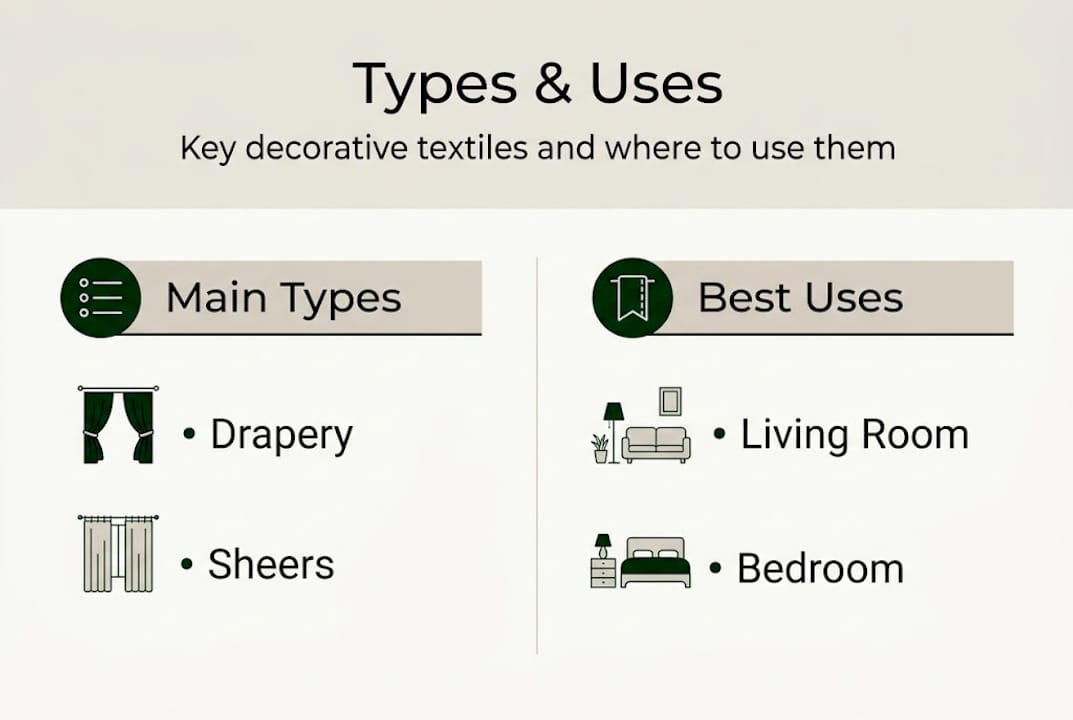
| Textile | Best room | Avoid using for |
|---|---|---|
| Sheer voile | Living room, bedroom | High-traffic upholstery |
| Jacquard | Formal dining, bedroom | Casual outdoor spaces |
| Canvas | Outdoor, workrooms | Delicate window drapes |
| Velvet | Bedroom, lounge | Humid or sunny rooms |
| Embroidered cotton | Accent pillows, valances | Heavily soiled areas |
Staying current with window fabric trends helps you align your selections with what is resonating in interior design right now.
Pro Tip: Before purchasing any fabric, hold a sample up to your window and let it drape naturally over your hand. If it falls in loose, flowing folds, it will likely work for curtains. If it stays rigid, reconsider using it for anything that needs to hang or pool.
How to choose the right decorative textile for your project
Selecting the right fabric requires more than picking a color you like. A structured approach saves you from expensive remakes and helps you get results that look intentional rather than improvised.
Step 1: Define the purpose. Before touching a swatch, decide what the textile needs to do. Block morning light? Soften acoustics? Add warmth to a neutral palette? Knowing the function narrows your options significantly.
Step 2: Measure carefully. Add 1.5 to 2.5 times the window width for fullness, and extend your rod 8 to 12 inches beyond the frame on each side. Panels that are too narrow look skimpy and visually shrink a window.
Step 3: Test the drape. Request fabric samples before committing. Drape the sample over a rod or chair back to see how it behaves. Stiff fabrics will bunch awkwardly; overly fluid ones may lack presence at large windows.
Step 4: Coordinate color with intention. Match your textile to a secondary color in the room rather than the dominant wall color. This creates visual contrast without clash and makes the room feel layered.
Step 5: Consider durability by room.
- Kitchen: Choose washable cottons or blends that resist grease and steam
- Bedroom: Prioritize light-filtering or blackout-lined panels for sleep quality
- Living area: Layer sheers with heavier drapes for maximum flexibility
Guide your decisions toward picking the perfect textile by matching fabric weight and weave to the room’s demands.
Pro Tip: Layer a sheer panel beneath a heavier drape and hang both on a double rod. You can close the sheer during the day for soft filtered light, then draw the drape at night for full privacy. This setup costs little more than a single-layer treatment but gives you far more control.
Smart DIY ideas for customizing your space
Knowing which textile to buy is only half the equation. Putting it to work creatively is where the real satisfaction comes from, and many of the most effective projects require minimal sewing experience.
Easy-sew valances are an excellent starting point. A single fabric width hemmed at the top and bottom can transform a bare window in an afternoon. Choose an embroidered cotton or a textured jacquard for immediate visual impact without complexity.
Updating throw pillows is the fastest way to shift a room’s color story seasonally. Cut fabric panels, fold wrong sides together, and finish with an envelope closure at the back. No zipper required.
Custom table runners showcase statement fabrics in a low-stakes format. A length of dupioni silk or woven brocade over a plain tablecloth adds instant elegance to a dining table without the cost of recovering chairs.
For window treatments, layering also delivers real thermal benefits, not just visual ones:
- A blackout lining behind a decorative panel reduces heat loss in winter
- Sheers diffuse harsh afternoon sun without making a room feel dark
- A third layer of a soft throw draped over a curtain rod creates a casual, textured look
As noted by experienced drapery makers, interlining adds insulation and helps drapes hang beautifully, which is why professional workrooms rarely skip it even when clients are cost-conscious.
“The difference between curtains that look custom and curtains that look homemade almost always comes down to interlining and proper fullness. Both are achievable for a careful DIYer.”
For installation basics, always use a level when mounting hardware, and confirm your wall anchors can support the loaded rod weight. A panel that falls mid-season is both frustrating and potentially damaging. Explore thoughtful approaches to layering window treatments for style, function, and comfort in every room.
A designer’s take: What most guides miss about decorative textiles
Most decorating advice defaults to matching: match your drapes to your pillows, coordinate your runner to your upholstery. That guidance keeps things safe, but it also produces rooms that feel flat and catalog-predictable.
The more interesting approach is to think about contrast in texture rather than uniformity in color. A matte linen panel next to a glossy jacquard throw creates the kind of visual tension that makes a room feel considered rather than decorated by formula. Smooth against nubby. Sheer against opaque. These pairings are what give a space its personality.
Small customizations also carry disproportionate impact. A simple trim along the leading edge of a drape, a contrast lining that peeks out when the panel moves, or an unexpected fabric on the back of a pillow all signal intentionality. They tell the room’s story in a way that mass-produced textiles simply cannot.
The goal is not perfection but confidence. Rooms that reflect genuine creative decisions, even imperfect ones, always feel more alive than rooms assembled from a single window treatment elegance lookbook. Trust your instincts, test combinations with samples first, and let the fabric’s inherent quality do most of the work.
Get started with premium decorative textiles today
Choosing quality fabric from the start saves you from redoing a project in six months. Beautiful Window Elgin carries a carefully selected range of decorative textiles suited to both interior window treatments and outdoor applications.

For a refined, formal look, the Delrose drapery panels offer rich dupioni texture with excellent drape and visual weight. For outdoor or weather-exposed projects, the outdoor canvas fabric provides a waterproof, durable option at 60 inches wide. Browse the full collection, request fabric samples, or book a custom design consultation to find exactly the right material for your next project.
Frequently asked questions
What’s the main difference between decorative and upholstery textiles?
Decorative textiles are lighter and chosen for aesthetics and flowing drape, while upholstery fabrics are heavier and engineered for long-term durability under friction and compression.
Can I use drapery fabric to upholster a chair?
It is not recommended because drapery fabric lacks the abrasion resistance and structural integrity needed for furniture upholstery, meaning it will wear out quickly.
What textile is best for layering window treatments?
Lightweight sheers work best beneath heavier drapes; layer sheers with drapes on a double rod so you can adjust light and privacy independently throughout the day.
How do I measure windows for custom drapes?
Measure the window width, then add 1.5 to 2.5 times that measurement for fullness, and position your rod 8 to 12 inches beyond the frame on each side for a well-proportioned finished look.
Recommended
- How to Choose the Right Fabric | Beautiful Windows Elgin Fabric Guide – Shop Designer Fabrics by the Yard | Curtains & Drapery
- What is designer textile? A guide to luxurious home fabrics – Fabric Store in Columbia, SC | Drapery Making Services
- Trending curtain fabrics for stylish windows in 2026 – Fabric Store in Columbia, SC | Drapery Making Services
- Fall Window Treatment Trends 2025: Warmth, Texture Tailored Elegance – Shop Designer Fabrics by the Yard | Curtains & Drapery
- Raised Print, Embossing, Debossing: Tactile Luxury Unveiled – BcardsCreation